
What is resin 3D printing?
3D printing is a digital fabrication technology for making three-dimensional objects. There are many kinds, and this guide focuses on resin 3D printers. It explains their features so that you can find the method that suits you.
Resin 3D printers build objects from a resin (a liquid acrylic material) that hardens when exposed to ultraviolet light. The process has been in practical use since the 1980s and is now used in many fields, including industrial products, medical devices and hobby items such as figures.
A key advantage of resin 3D printers is high accuracy. Using light, they can make fine curved surfaces and delicate structures, so they suit precise parts and medical devices. Many kinds of materials can be used, which makes them useful for a wide range of purposes.
One drawback is that printing can be slow: when the light is applied point by point, as in SLA, printing takes longer than with many other 3D printers. The special materials and light sources also call for more specialist knowledge than common 3D printers.
Resin printing is divided into three methods: SLA (Stereolithography), DLP (Digital Light Processing) and LCD (Liquid Crystal Display). Let us look at the features, advantages and disadvantages of each.
Three ways to apply the light
As described above, resin printing builds a 3D object by shining UV light onto resin. It is divided into three methods by how the UV light is applied: SLA (Stereolithography), DLP (Digital Light Processing) and LCD (Liquid Crystal Display). The diagram below shows the differences.
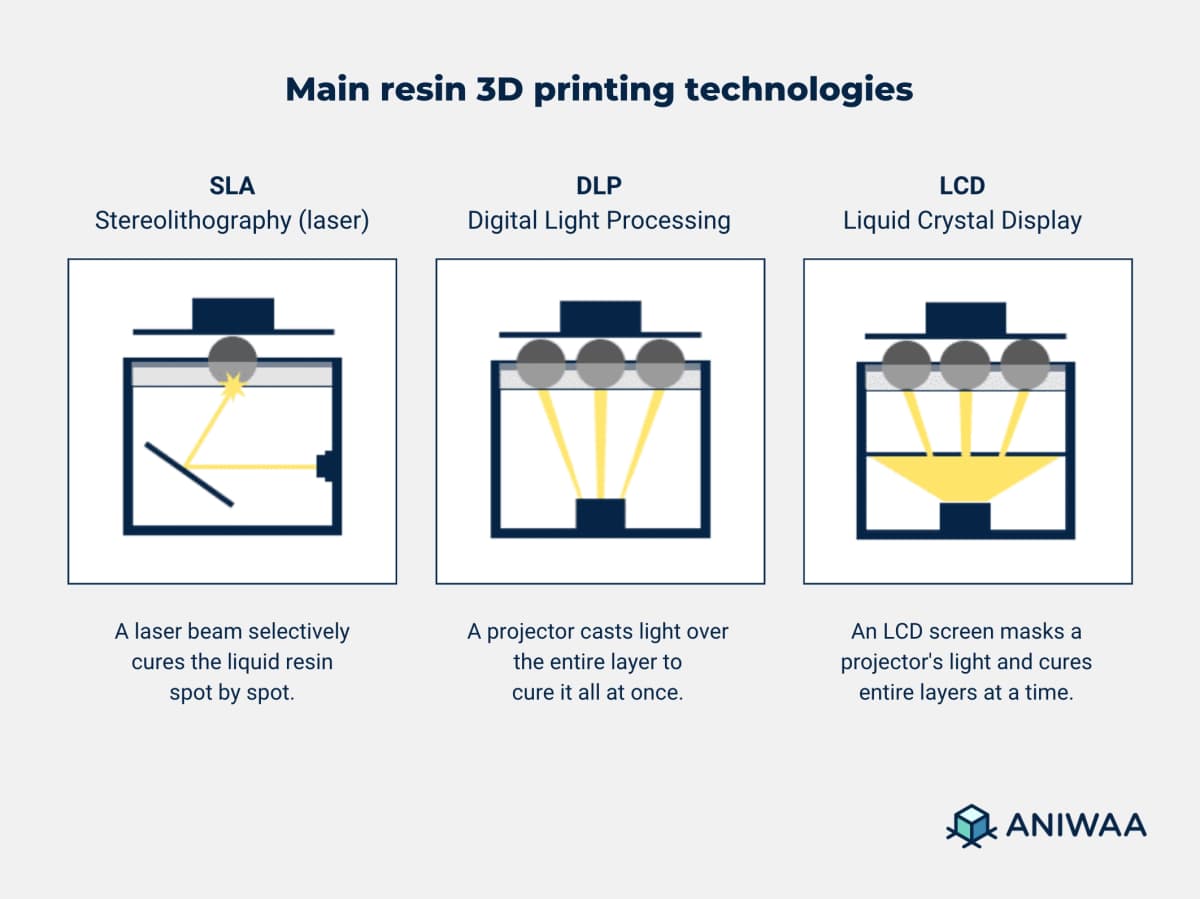
SLA
Stereolithography (laser)
A single UV laser is aimed at the areas to be printed to cure the resin.
The light is applied as a “point”.
DLP
Digital Light Processing
Like a projector, a light source shines UV light only onto the areas to be printed to cure the resin.
The light is applied as a “surface”.
LCD
Liquid Crystal Display
A lamp gives off constant UV light, and an LCD panel (liquid crystal panel) filters it so that only the areas to be printed are exposed and cured.
Like DLP, the light is applied as a “surface”.
The difference comes down to whether the UV light reaches the area to be printed as a “point” or a “surface”, and, for a surface, whether it is projected like a projector or passed through an LCD panel like those in TVs.
Next, we look at the specific features, advantages and disadvantages of SLA, DLP and LCD one by one.
Features of SLA (Stereolithography)
As described above, SLA aims a UV laser at resin that cures under ultraviolet light. The accuracy depends on the diameter of the laser, which is very small (tens of µm), so the finish is very fine.
However, because a single thin laser scans the build area, large objects take a long time to print. SLA printers with several lasers are now on the market, developed to make up for this drawback.
Advantages and disadvantages of SLA
Here are the advantages and disadvantages of SLA 3D printers, for those choosing between the resin printing methods.
Advantages
- Very high accuracy
→ The UV laser is very thin (tens of µm), so surfaces come out very smooth.
Disadvantages
- Relatively long print times
→ The UV light is applied to a very small point at a time.
When SLA is a good fit
- When you want highly accurate prints
- When print time is not a constraint
How SLA works in detail
This video shows clearly how an SLA 3D printer works. It is made by Formlabs, a company that sells SLA 3D printers.
Features of DLP (Digital Light Processing)
DLP stands for Digital Light Processing and is one of the resin 3D printing methods. It makes three-dimensional objects by photocuring, which uses high-energy light such as ultraviolet light to harden materials such as resins and polymers.
You may have heard the name DLP when buying a projector. DLP works exactly like a projector, shining light only on the parts to be printed. A DLP printer exposes a whole layer at once (it prints by surface), so it prints faster than an SLA printer. The focus can be adjusted, so the UV light can be both precise and intense. However, as the build area gets larger, the resolution of the projector drops, so DLP is not suited to large objects.
Advantages and disadvantages of DLP
Here are the advantages and disadvantages of DLP 3D printers, for those choosing between the resin printing methods.
Advantages
- Fast printing
→ It prints by “surface”, so it is faster than SLA. - UV intensity and resolution can be adjusted, allowing accurate and strong prints
→ The focus of the light source can be adjusted, so small objects can be printed with tightly focused light.
Disadvantages
- Hard to print large parts with high accuracy
→ When light covers a large area, it gradually becomes blurred.
When DLP is a good fit
- When you want small, highly accurate prints
- When you want to print small objects quickly
- When you want large prints that do not need high accuracy
For more on DLP printers, see the guide below.
More about Digital Light Processing (DLP)
Features of LCD (Liquid Crystal Display)
LCD stands for liquid crystal display, and this method uses an LCD panel when exposing the resin. An LCD panel can easily control which parts let light through and which block it. An LED light shines toward the resin, and only the areas to be printed let the light through. This is repeated for each layer. On 3Techs this method is listed as LCD (mSLA).
LCD panels are inexpensive to source, so LCD 3D printers are relatively low-cost. Because a whole layer is printed at once, print times are shorter than with SLA. However, LCD cannot adjust the focus as DLP can, so the exposure time stays the same regardless of the size of the object. With DLP, the exposure time can be changed, for example by adjusting the focus.
Advantages and disadvantages of LCD
Here are the advantages and disadvantages of LCD 3D printers, for those choosing between the resin printing methods.
Advantages
- Low-cost printers
→ The parts are inexpensive, and many printers are affordable. - Fast printing
→ It prints by “surface”, so it is faster than SLA.
Disadvantages
- Exposure time per layer is fixed regardless of the part size, so print time is hard to shorten
→ With DLP, print time can change with the size of the object.
For more on LCD printers, see the guide below.
More about LCD (mSLA)
Summary: features of resin 3D printing
The features of the three resin printing methods are summed up below.
| Advantages | Disadvantages | |
|---|---|---|
| SLA |
|
|
| DLP |
|
|
| LCD |
|
|
Resin 3D printers come in three methods depending on how the UV light is applied, and each has its own features.
This page introduces SLA resin 3D printers, which take longer to print but are very accurate.
Stereolithography printers on 3Techs
The Stereolithography printers listed on 3Techs, with build size, price and other specs side by side.
See all 148 Stereolithography printers