
Plastic products are usually made by injection molding or extrusion. In injection molding, a mold is made first, and an injection molding machine forces molten plastic into it at high pressure. The mold is expensive to make, but once it exists, plastic parts can be produced cheaply in large numbers. This is why these processes are common for products made in large lots.
On the other hand, plastic 3D printing is said to be best suited to small-batch production and prototyping. A 3D printer builds a part by stacking layers, and unlike injection molding it needs no mold, so it suits making small numbers of parts. It can also make complex shapes that are impossible or difficult to make with a mold, which is another feature of 3D printing.
There are already many ways to make plastic parts, and the best choice depends on the production volume and the stage of your project.
Types of 3D printers
The materials used in 3D printers fall into two broad groups: plastics and metals. This guide focuses on 3D printers that use plastic materials.
Plastic 3D printers
There are four main types of 3D printers that can print plastic materials. Resin printing is further divided by how the light is applied into three methods: SLA (Stereolithography), DLP (Digital Light Processing) and LCD (Liquid Crystal Display).
- Resin printing (SLA, DLP, LCD)
- Fused Deposition Modeling (FDM)
- Selective Laser Sintering (SLS)
- Inkjet (Material Jetting)
The table below briefly sums up the features and price ranges of these four types. Each method is explained in more detail below the table.
| Method | Features | Price range |
|---|---|---|
| Resin printing (SLA, DLP, LCD) | Low cost, fast printing, needs extra equipment | JPY 20,000 to 10 million |
| Fused Deposition Modeling (FDM) | Low cost, no extra equipment needed | JPY 20,000 to 50 million |
| Selective Laser Sintering (SLS) | Fairly expensive machines, strong parts, needs extra equipment | JPY 1 million to 100 million |
| Inkjet (Material Jetting) |
Price ranges are rough figures for the Japanese market, in Japanese yen.
Resin printing (SLA, DLP, LCD)
Resin printing uses a UV-curable resin, a liquid that hardens under ultraviolet (UV) light, and builds a 3D object by shining UV light onto it. The video below, from Formlabs, a company that makes and sells resin 3D printers, shows how resin printing (the SLA method) works.
There are three main resin printing methods: SLA (Stereolithography), DLP (Digital Light Processing) and LCD (Liquid Crystal Display). All of them cure resin with UV light; they differ in how the light reaches the resin. Some UV-curable resins are harmful to people, so you need to wear gloves when handling them, and prints need post-processing with IPA (isopropyl alcohol) or a similar solvent. Handling the material takes some care.
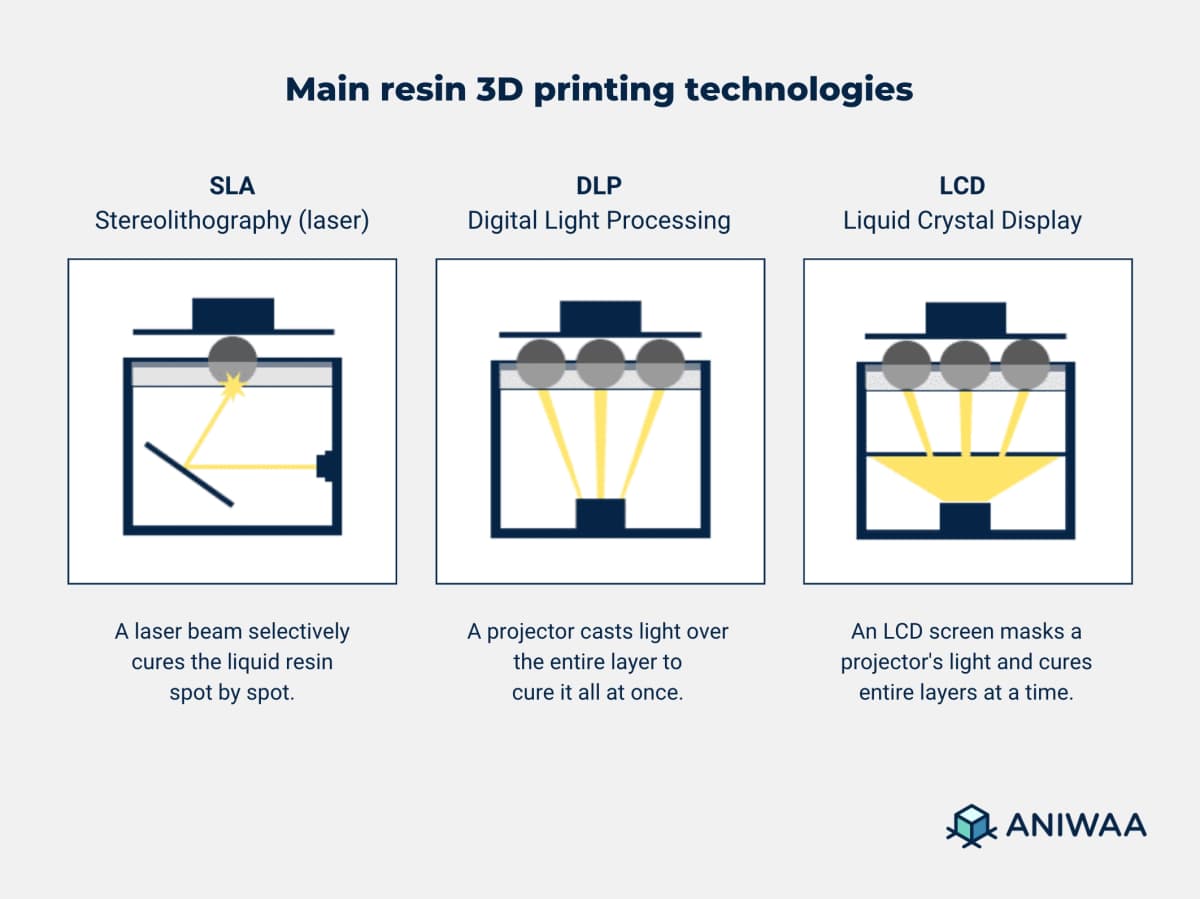
SLA (Stereolithography)
SLA is a resin printing method that builds an object by tracing a single laser beam over UV-curable resin. The accuracy depends on the diameter of the laser beam, and in general it can make complex, finely detailed objects. Because a single laser draws the whole shape, printing takes time and the build area is hard to make large. Printers that use several lasers at once are now on the market and are addressing these issues.
More about Stereolithography (SLA)
DLP (Digital Light Processing)
DLP builds an object by shining light from something like the projector in a meeting room onto UV-curable resin. SLA takes time because it uses a single laser, while DLP can cure a whole layer at once, so it prints relatively fast. On the other hand, making the projected area larger to print bigger objects lowers the resolution of the projector, so DLP is not suited to large prints.
More about Digital Light Processing (DLP)
LCD (Liquid Crystal Display)
An LCD is the liquid crystal panel familiar from screens. In the LCD method, a UV light shines through an LCD panel onto UV-curable resin. The panel lets light through only where the resin should cure, which forms the object. Like DLP, LCD exposes a whole layer at once, so it prints relatively fast. Accuracy depends on the resolution of the LCD panel; typical hobby resin printers use 4K panels, and machines with 8K panels are also on the market, so accuracy keeps improving. The structure is simple and LCD panels are inexpensive, so LCD resin printers are available at quite affordable prices. On 3Techs this method is listed as LCD (mSLA).
More about LCD (mSLA)
Fused Deposition Modeling (FDM)
Fused Deposition Modeling (FDM) builds an object by melting material with heat. A plastic material shaped like a cable is melted and pushed out of a nozzle, drawing the object as if in a single stroke.
The nozzle tip is heated to 100 to 250°C to melt the material, which is stacked layer by layer. Common issues are warping when the plastic cools and visible layer lines on each layer.
More about Fused Deposition Modeling (FDM)
Selective Laser Sintering (SLS)
Selective Laser Sintering (SLS) builds an object by melting plastic powder with a laser. When the print is finished, the object is dug out of the powder, much like digging up a fossil.
SLS melts the material with a powerful laser into a dense solid, so it can make strong parts. The support structures that resin printing and FDM need to hold the shape are not needed in SLS. On the other hand, the machine needs space to handle the powder, so it is large, and parts are very hot after printing, so they need plenty of time to cool before they can be taken out.
More about Selective Laser Sintering (SLS)
Inkjet (Material Jetting)
Inkjet printers can make colored objects. Patterns on 3D printed parts are usually added after printing, by painting or transfer printing. Inkjet printing colors the material directly, which simplifies the production process. The finish is also very clean, so it is used in fields such as art.
The video below introduces Material Jetting (PolyJet) by Stratasys.
Most inkjet 3D printers use the same kind of light-curing material as resin printing, and the method is also called Material Jetting. Colors and additives can be added to the material, so Material Jetting printers can make full-color models and models with different hardness. Stratasys PolyJet jets light-curing resin like ink and cures it with UV light to build the object.